 An official website of the United States government



Defining Exposure Units

ATSDR has developed specific guidance that teaches health assessors how to identify exposure units for a completed or potential exposure pathway. The guidance also teaches how to compile data for your specific scenarios.
When it comes time to do your public health evaluation, refer to the ATSDR’s Guidance on Identifying Exposure Units for the Public Health Assessment Process. The Associate Director for Science (ADS) group is also a good source of information if you have questions about exposure units.
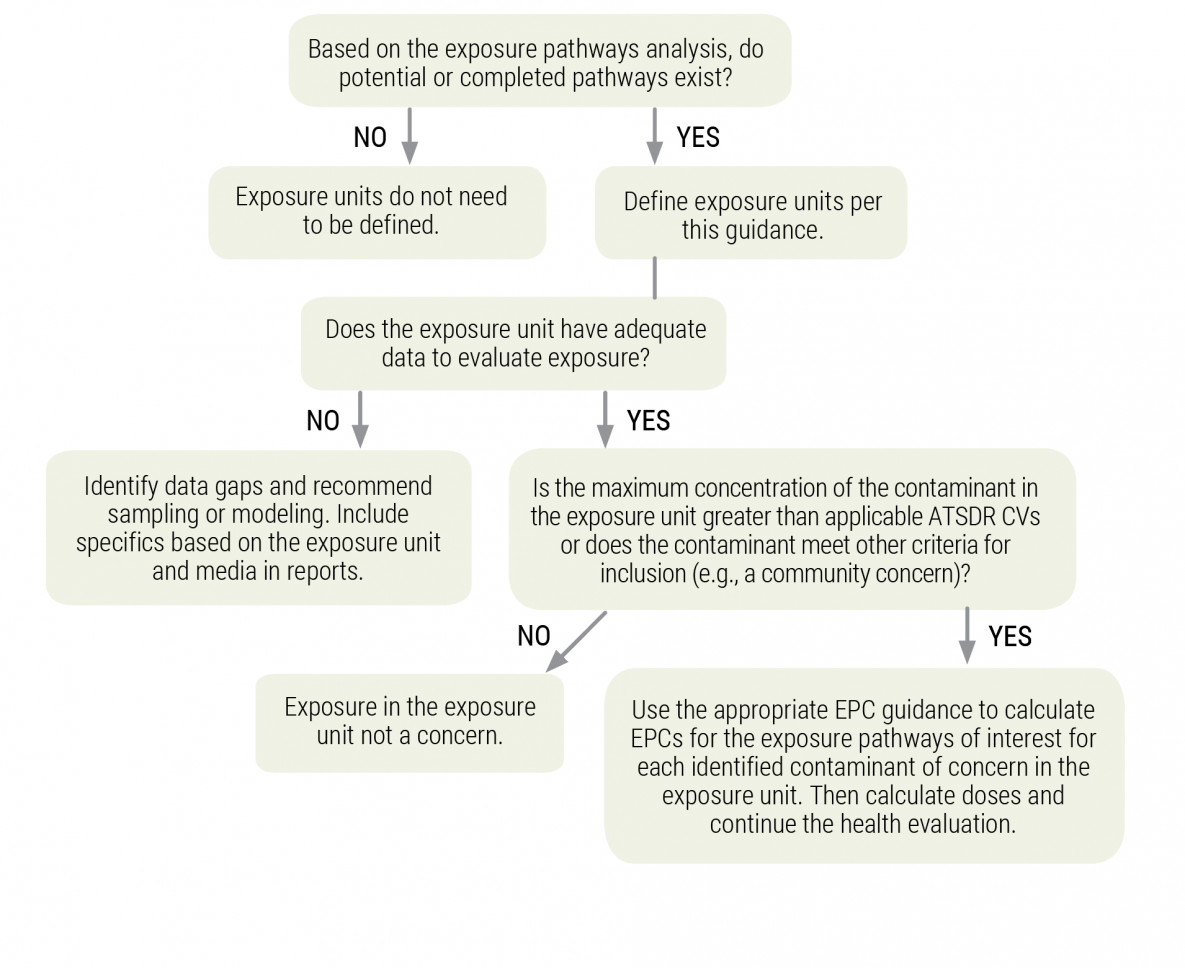
ATSDR developed the following process to define and evaluate exposure units. This flowchart shows how exposure units are defined within the PHA.
You should consider several factors when defining exposure units:
- Exposure units can vary greatly in size.
- Sites may have multiple exposure units.
- Exposure units are defined by people’s activities and not by available environmental data.
- An exposure unit might never have been sampled. For example, at sites with widespread groundwater contamination, separate exposure units may need to be identified for different private wells that draw from the contamination plume – including private wells that have never been sampled).
- Exposure units can vary by conditions of exposure.
- Exposure units may inform environmental sampling.
- Exposure units may not be defined at all sites, depending on the nature of the data.
In addition, consider the following information when defining exposure units:
- Conceptual site model and exposure pathways analysis
- Observations made and pictures taken during site visits
- Maps and aerial photographs
- Discussions with residents, community groups, and tribal leaders
- Institutional controls (such as fishing advisories and hunting regulations)
- Physical barriers (such as fences or locked gates)
- Discussions with officials from other agencies (like EPA and state, tribal, and local health agencies)
Now, let’s go through some examples to practice defining exposure units.
Five homes were built along an area that passes over a groundwater plume. The homes have unfinished basements. Indoor air samples were collected at the homes. The results suggest the potential for intrusion of volatile groundwater contaminants into the homes’ indoor air. Accordingly, the health assessor identified vapor intrusion as a completed exposure pathway that required further evaluation.

Question: How should you, as the health assessor, define the exposure units shown here?
Answer: You should designate the indoor air in each home as its own exposure unit. Do NOT combine them to make a single exposure unit. The homes should be evaluated separately because
- exposure units are defined by locations where people spend their time and not on contamination levels, and
- each home may have unique assumptions that need to be factored into the exposure dose calculations.
An elementary school has a large field that is completely open for children to play before, during, and after school. The field contains four areas where contaminated fill was previously disposed. Children are known to frequent all parts of the field.

Question: How should you define the exposure units to evaluate?
Answer: You should define one exposure unit for the entire field of the elementary school. Do NOT define different areas within the field as separate exposure units. This decision is based on our knowledge that children play in all parts of the school field, rather than in just certain areas within the field.
However, if you know that children predominantly play in one part of the field, you can treat that portion of the field as a separate exposure unit.
Lead and arsenic were emitted from the smokestacks of a former smelter. The contaminated particles were transported via air and settled across the yards of 20 properties in a residential neighborhood.

Question: How should you define the exposure units to evaluate?
Answer: You should define each residential yard as an individual exposure unit. Do NOT define all homes in the neighborhood as a single exposure unit. This decision is based on the knowledge that residents spend time on their own properties.
Now, let’s go to the next “Practice” section to apply what has been discussed about exposure units.