Hair Analysis Panel Discussion: Section 2.2
Section 2
2.2 Purpose of the Meeting and Charge to the Panelists
Allan Susten, Ph.D., D.A.B.T.
Assistant Director for Science
ATSDR/DHAC
Dr. Susten described how the agency seeks to use the best available
science in conducting its public health assessments. He indicated
that the overarching goal for the panel discussions is to review
the state of the science of the hair analysis field and help the
agency evaluate the overall utility of hair analysis in its public
health assessments. Specifically, the agency seeks to determine
when it might be appropriate to use hair analysis in evaluating
possible exposures and/or possible adverse health effects associated
with environmental toxicants. Dr. Susten acknowledged that hair
analysis is used for other purposes (e.g., drugs of abuse, forensics)
but said that the focus of this forum was on the relevance of hair
analysis to hazardous waste site evaluations.
To help illustrate the nature of the scientific input that helps
the agency evaluate exposures and health effects, Dr. Susten displayed
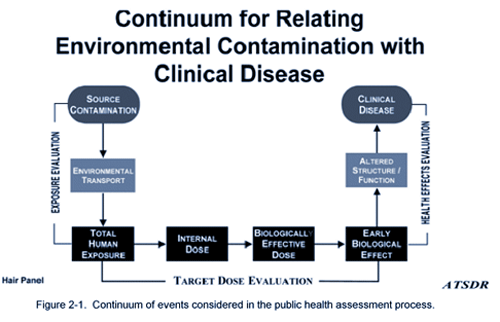
a "continuum" showing the components of ATSDR's public health assessment
process (see Figure 2-1). In doing so, he described
the following components of the process:
- Exposure evaluation—Involves studying how hazardous substances can reach people, studying the means by which people can come in contact with hazardous materials, and determining the exposure concentration or dose at the point of contact.
- Target dose evaluation—Involves studying the distribution of a hazardous substance once it enters the human body and determining the internal and biologically effective doses.
- Health effects evaluation—Takes a closer look at the dose-response relationships of the substance(s) under evaluation and how the substance exerts its effect.
Dr. Susten explained that it is not enough to look at the estimated exposure concentration or exposure dose when evaluating the potential that a particular exposure will lead to clinical disease. To better understand the extent of exposures and the potential that a particular exposure will lead to disease, one needs to study the biology and the toxicology of the substance involved. Therefore, where possible, the agency seeks ways to estimate or measure internal dose and to assess whether such exposures might be associated with adverse health effects.
Through its work over the past decade or so, ATSDR has recognized that knowledge of environmental concentrations of hazardous substances alone is not enough to evaluate possible health effects. In response, the agency established a special "exposure investigation" (EI) section within DHAC to look specifically at biomonitoring and how it can be used to further inform the public health assessment process. Dr. Susten presented the criteria developed by ATSDR to determine whether biomonitoring should be considered to evaluate a site-specific exposure situation:
- Can an exposed population be identified?
- Does a data gap exists that affects ATSDR's ability to interpret
whether a public health hazard exists?
- Can the data gap be filled with an EI?
- How would the EI results impact public health decision-making?
Dr. Susten stated that the panel's charge is to discuss scientific issues related to hair analysis that will help the agency determine the criteria for determining when hair analysis might be a useful tool in assessing public health exposures. He recognized that the science may not be available to support all analyses and that research may be needed.
In convening this panel, Dr. Susten emphasized, the agency's goal was to receive panelist and observer input on the following general questions:
- When is it appropriate to consider hair analysis in assessing
human exposures to environmental contaminants?
- When is it inappropriate to consider hair analysis in assessing
human exposures to environmental contaminants?
- What data gaps exist that limit the interpretation and use
of hair analysis in the assessment of environmental exposures?
What research is needed to fill these gaps?
- For what substances do reliable hair analysis methods exist (e.g., trace elements, organic compounds)?
ATSDR's primary interest in hair analysis, as was reiterated throughout the meeting, is using the best science when responding to an individual's request to interpret hair analysis results and determining when hair analysis at the population level may be helpful in demonstrating that an environmental exposure has occurred.
Contact Us:
- Agency for Toxic Substances and Disease Registry
4770 Buford Hwy NE
Atlanta, GA 30341-3717 USA - 800-CDC-INFO
(800-232-4636)
TTY: (888) 232-6348
Email CDC-INFO - New Hours of Operation
8am-8pm ET/Monday-Friday
Closed Holidays